
THE BOOK
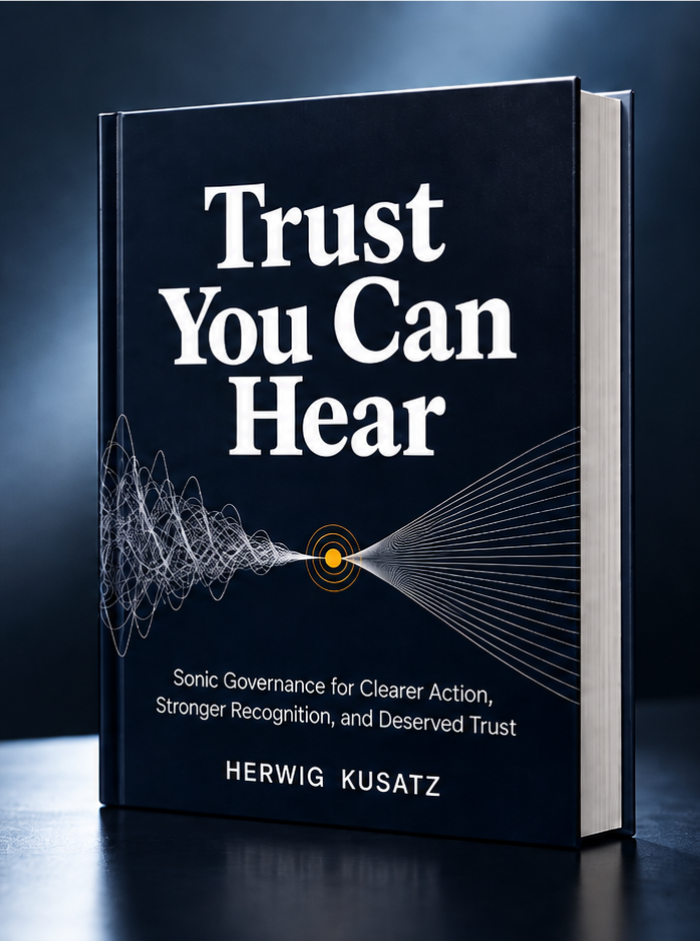
Trust You
Can Hear
Sonic Governance for Clearer Action, Stronger Recognition, and Deserved Trust.
THE DEFAULT PROBLEM
Your organisation already has a sound.
It is heard through voices, calls, announcements, alerts, interfaces, meetings, spaces, synthetic speech, music, silence, and the small signals that tell people whether something has begun, failed, changed, or finished.
Much of that sound may never have been chosen as a whole. It still forms a system.
Without shared intent, defaults set the direction.
Without clear ownership, local preference fills the gap.
Without rules, deadlines, technology, vendors, and convenience make the decisions.
This is not a gap in taste.
It is a gap in governance.
WHY GOOD SOUND STILL FAILS
Three recurring failures.
Sonic Friction
Sound adds effort, ambiguity, or missed information.
⎯
Action takes more effort.
Sonic Anonymity
Sound may function without building recognition where it matters.
⎯
Recognition remains weak.
Sonic Drift
Meaning, character, or use changes without governed continuity.
⎯
Trust becomes harder to sustain.
Function comes first.
Recognition matters where it serves a legitimate purpose.
Continuity protects what works without freezing what needs to change.
THE DISCIPLINE
Sound has consequence.
Responsibility should follow.
Sonic Governance is the organisational discipline for deciding how sound is chosen, used, changed, evaluated, and held accountable across an organisation over time.
It goes beyond individual sonic assets. It asks what sound should achieve. What should be heard. What should remain silent. Who has authority to decide. What must hold. What may adapt. And what evidence should change the decision.
Sonic Governance does not replace sound branding, audio UX, acoustic engineering, accessibility, service design, or communications governance. It governs the seams where their decisions meet.
THE FRAMEWORK
A system for governing what people hear.
Structure the system. Operate it in context. Learn from evidence.
STRUCTURE

Four Sonic Domains
What makes up the audible system?
Voice · Cues · Music · Atmosphere
Silence is a governing
choice across all four.

Governance Reach
How far does your authority reach?
Owned · Influenced · External
Decide directly. Shape where possible. Respond where control ends.

Sonic Right-of-Way
What takes precedence?
Lead · Support · Recede
When audible claims compete, decide what should lead.
OPERATION & LEARNING

SIGNAL
How is the system governed over time?
Strategize · Identify · Guide ·
Nurture · Adapt · Leverage
Six recurring responsibilities.
Not a linear process.
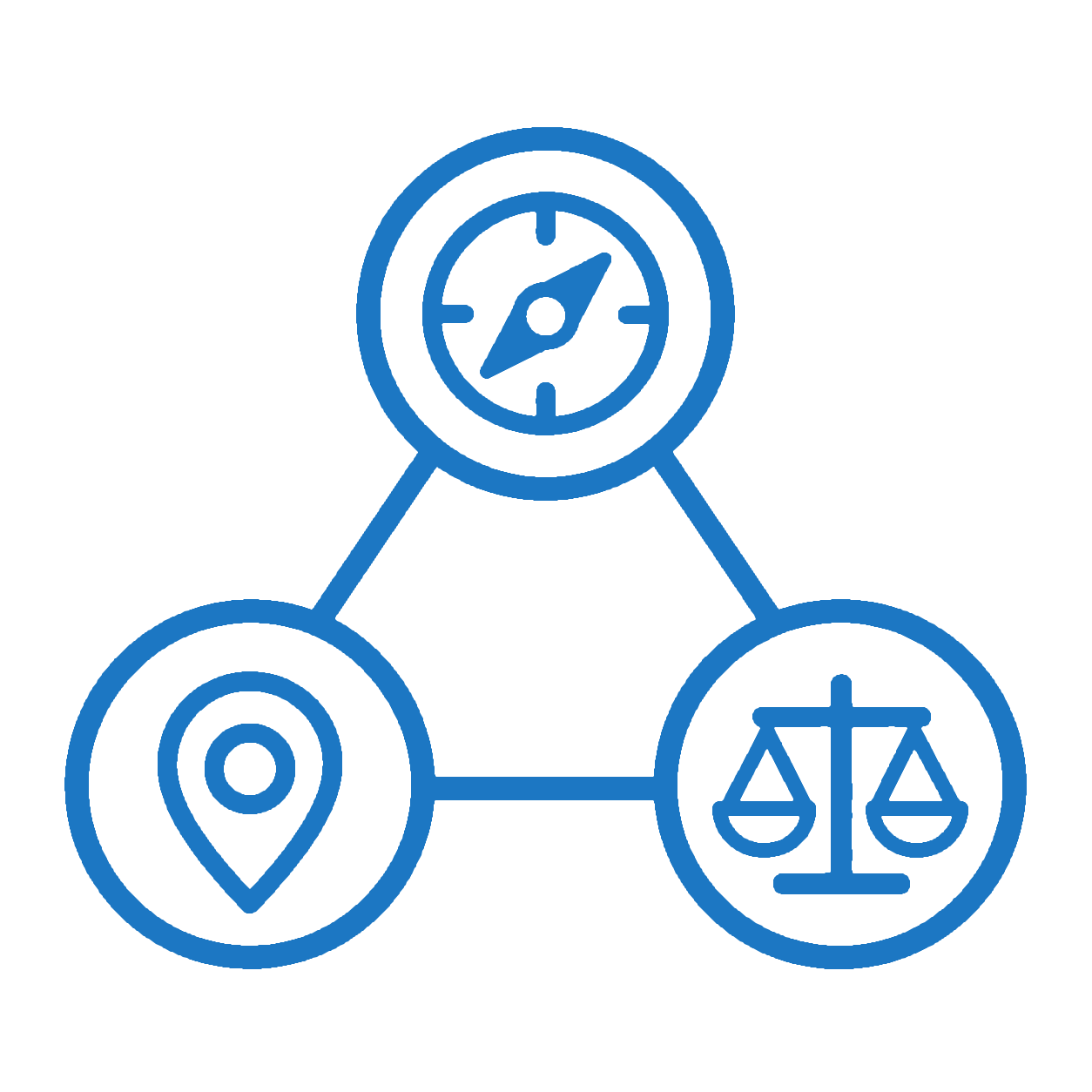
FIT
How should principles apply here?
Foundation · Instance · Trade-off
What must hold?
What is true here?
What response is justified?

The Audible Ledger
How does evidence change decisions?
Need · Baseline · Evidence ·
Guardrails · Ownership ·
Threshold · Decision · Review
Makes decisions traceable
and evidence actionable.
THE ETHICAL CENTRE
Make trust easier to hear.
A coherent voice cannot make an organisation honest. A recognisable motif cannot make a service reliable.
A reassuring atmosphere cannot compensate for inaccessible information, hidden authority, or broken promises.
Sound can help perception align with reality. It can make a clear system easier to navigate, a responsible service easier to understand, and reliable conduct easier to recognise.
Sound cannot manufacture deserved trust. It can make deserved trust easier to hear.
- Clarity before coercion.
- Agency before compliance.
- Accessibility and safety before distinctiveness.
- Silence when silence serves people better.
FOREWORD
"At that point, design alone is no longer enough."
— Hannes Raffaseder
Professor of Audio Design, author of Audiodesign, composer, Chief Executive Officer of USTP – University of Applied Sciences St. Pölten, and President of the European University Alliance E³UDRES²
In his foreword, Hannes Raffaseder places Trust You Can Hear in a wider shift from acoustic design towards organisational responsibility. He describes the book as moving attention from individual design elements to the way an organisation deals with sound as a whole.
"Listening is not a peripheral concern of organisational design."
THE ARGUMENT
From unmanaged sound to accountable conduct.
Part One
Why Sound Fails
- How sound accumulates by default.
- The noise tax and its consequences.
- Why perception begins early.
- Why strong sonic work still fails.
Part Two
How Sound Becomes Governed
- Build the Sonic Architecture.
- Run SIGNAL.
- Make the system hold.
- The next interface and synthetic voice.
- The Audible Ledger.
The book closes with an Executive Readiness Toolkit to help leaders recognise where consequential sound is not yet governed and what the next accountable question should be.
HEAR THE BOOK
Some arguments in this book are easier to understand when heard.
The listening companion provides purpose-built audio examples for the Four Sonic Domains, intelligibility, Sonic Right-of-Way, and synthetic voice, followed by an authentic Wiener Linien example showing one audible system in practice.
ABOUT THE AUTHOR

Herwig Kusatz
Herwig Kusatz is the author of Trust You Can Hear, creator of SIGNAL, and founder of Sound Strategy ))).
For more than twenty years, he has developed and advised on audible systems across public transport, services, products, interfaces, communications, and environments. His work includes Wiener Linien, ÖBB, and adidas.
He taught at university for eight years. His work has received six International Sound Awards, and he has served four times as an international jury member.
GET THE BOOK
Choose your edition.
Paperback
143 pages · English
First edition 2026
ISBN 978-3950632408
Amazon worldwide
Hardcover
143 pages · English
First edition 2026
ISBN 978-3950632415
Amazon worldwide
eBook
English
First edition 2026
ISBN 978-3950632422
Your organisation already has a sound. The question is whether it is governed.
Terms • Privacy • Imprint • Resources