
THE LISTENING COMPANION
Hear the Book
Some arguments are easier to understand when heard.
These five listening examples move from isolated principles to one real system in practice. Examples 1–4 are purpose-built demonstrations created for this companion. Example 5 uses authentic Wiener Linien project material.
Headphones are recommended, but not required. For A/B comparisons, keep your playback volume unchanged.
01 • FOUR SONIC DOMAINS
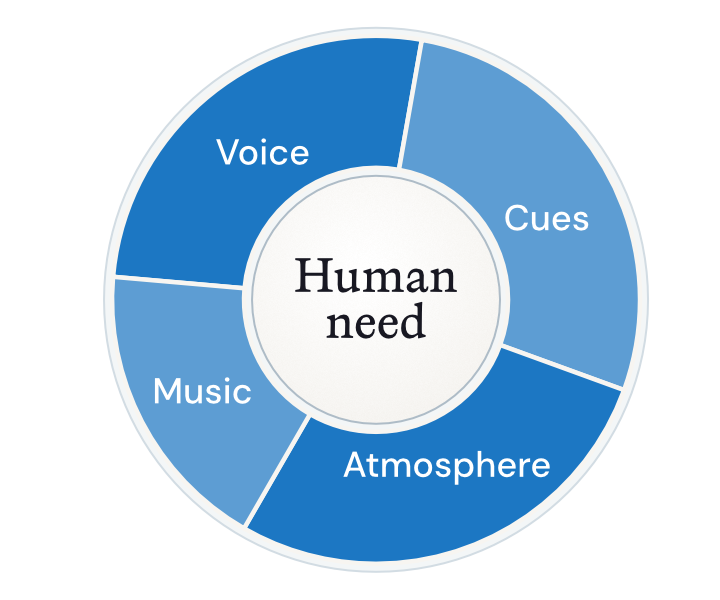
Four jobs. One audible field.
Voice, Cues, Music, and Atmosphere are defined by what they do, not by file type. These four clips isolate each role within the same fictional service environment.

A • VOICE
Meaning • Intent • Humanity

B • CUE
Status • Transition • Action

C • MUSIC
Emotion • Energy • Expectation

D • ATMOSPHERE
Space • Context • Orientation
02 • INTELLIGIBILITY
Same words. Different channel.
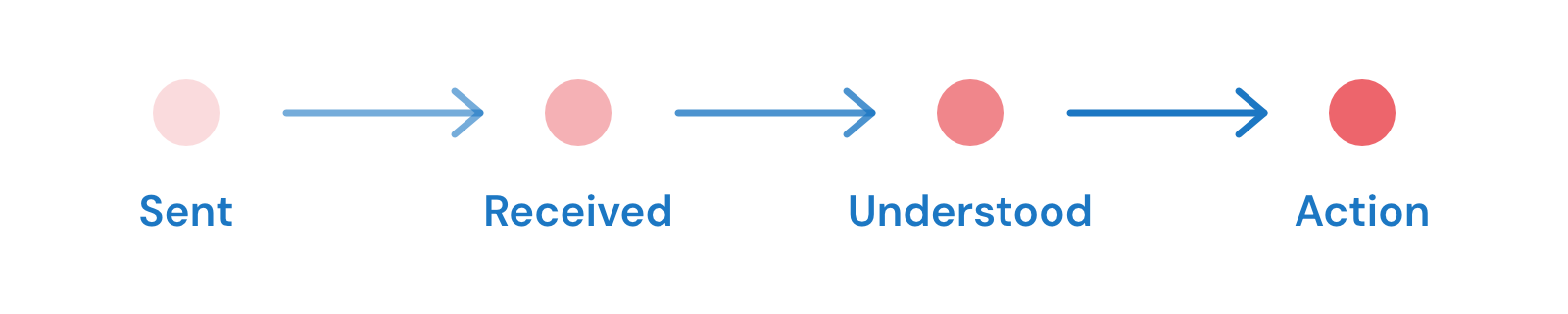
Communication succeeds only when what is sent can actually be received and understood in context.
A • REFERENCE
Clear, direct, and easy to understand.
B • CONSTRAINED CHANNEL
Same message. Reduced clarity and greater listening effort.
A • REFERENCE
The voice is clear, direct, and close. Speech detail remains intact and there is little acoustic interference.
The same recording is deliberately narrowed, reverberant, and partly masked by environmental sound. The words remain understandable, but listening requires more effort.
Version B is a simulated transmission condition created for this demonstration.
03 • SONIC RIGHT-OF-WAY
Same elements. Different precedence.
You have already heard the voice, cue, music, and atmosphere separately. Now hear what happens when those same elements share one moment.

A • COMPETING CLAIMS
Several elements compete for attention.
B • ASSIGNED RIGHT-OF-WAY
The same elements follow a clear order.
Cue, voice, music, and atmosphere overlap with similar prominence. The announcement has to compete for attention.
The cue leads briefly and then yields. The voice takes priority while the music recedes. Atmosphere remains present as context.
04 • SYNTHETIC VOICE
Same voice. Different authority.
The voice quality remains constant. What changes is what the listener knows about the system, what it may do, and where its authority ends.
A • UNDISCLOSED
No disclosure. Authority unclear.
B • DISCLOSED + BOUNDED
Clear disclosure. Authority defined.
C • HUMAN HANDOFF
Authority ends. Human handoff.
05 • ONE SYSTEM IN PRACTICE
Different expressions. One system.
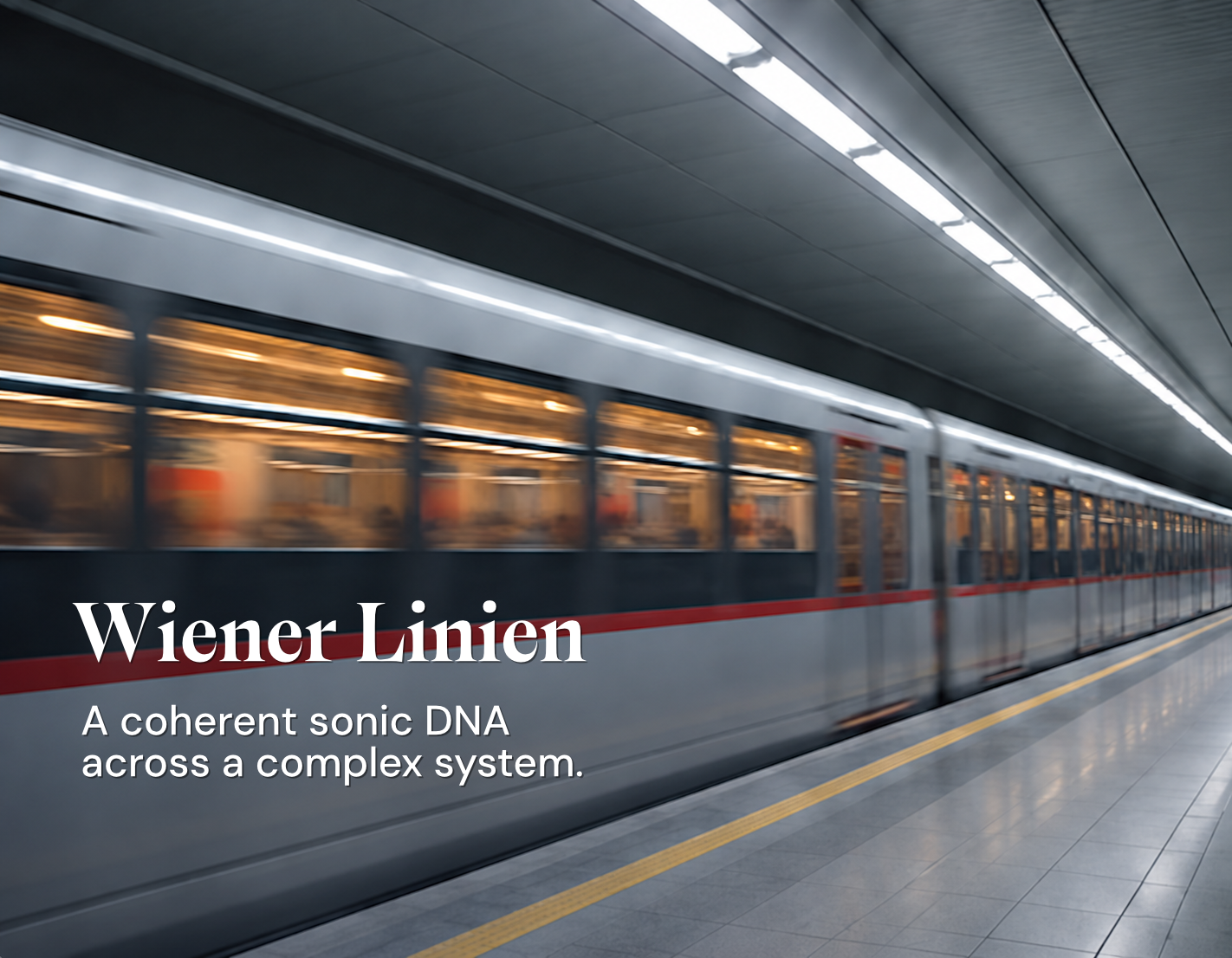
This real-world sequence shows how one audible system can remain coherent across very different applications.
Wiener Linien
A short listening sequence
0:00 Brand Signature
0:05 Passenger Information
0:11 Telephone Service
0:20 Children’s Communication
0:27 Image Film
0:33 Future Vision
“Wiener Linien. Die Stadt gehört dir.”
Wiener Linien. The city is yours.
“Westbahnhof. Umsteigen zu U6.”
Westbahnhof. Change here for the U6.
“Die Mitarbeiter und Mitarbeiterinnen unserer Telefonzentrale melden sich sofort nach Freiwerden einer Leitung.”
Our telephone service team will answer as soon as a line becomes available.
Children singing:
“Die Stadt gehört dir, egal wohin wir auch fahren, die Stadt gehört dir.”
The city is yours, no matter where we travel, the city is yours.
Instrumental. No spoken words.
Instrumental. No spoken words.
A short sonic logo leads into a spoken identification of Wiener Linien and the claim “Die Stadt gehört dir.”
A station gong introduces a concise announcement naming Westbahnhof and the connection to the U6.
Music begins in the foreground, then recedes as the service message starts, leaving space for the voice before returning.
Children sing a playful version of the line “Die Stadt gehört dir,” extending the same verbal idea into a very different tone and audience.
A relaxed instrumental passage shifts the system into a more atmospheric and image-led expression.
A more technological, forward-looking musical passage closes the montage with a different energy and character.
A governed system does not make every moment sound the same.
It makes variation possible without losing the whole.
NEXT STEP
Hear differently now?
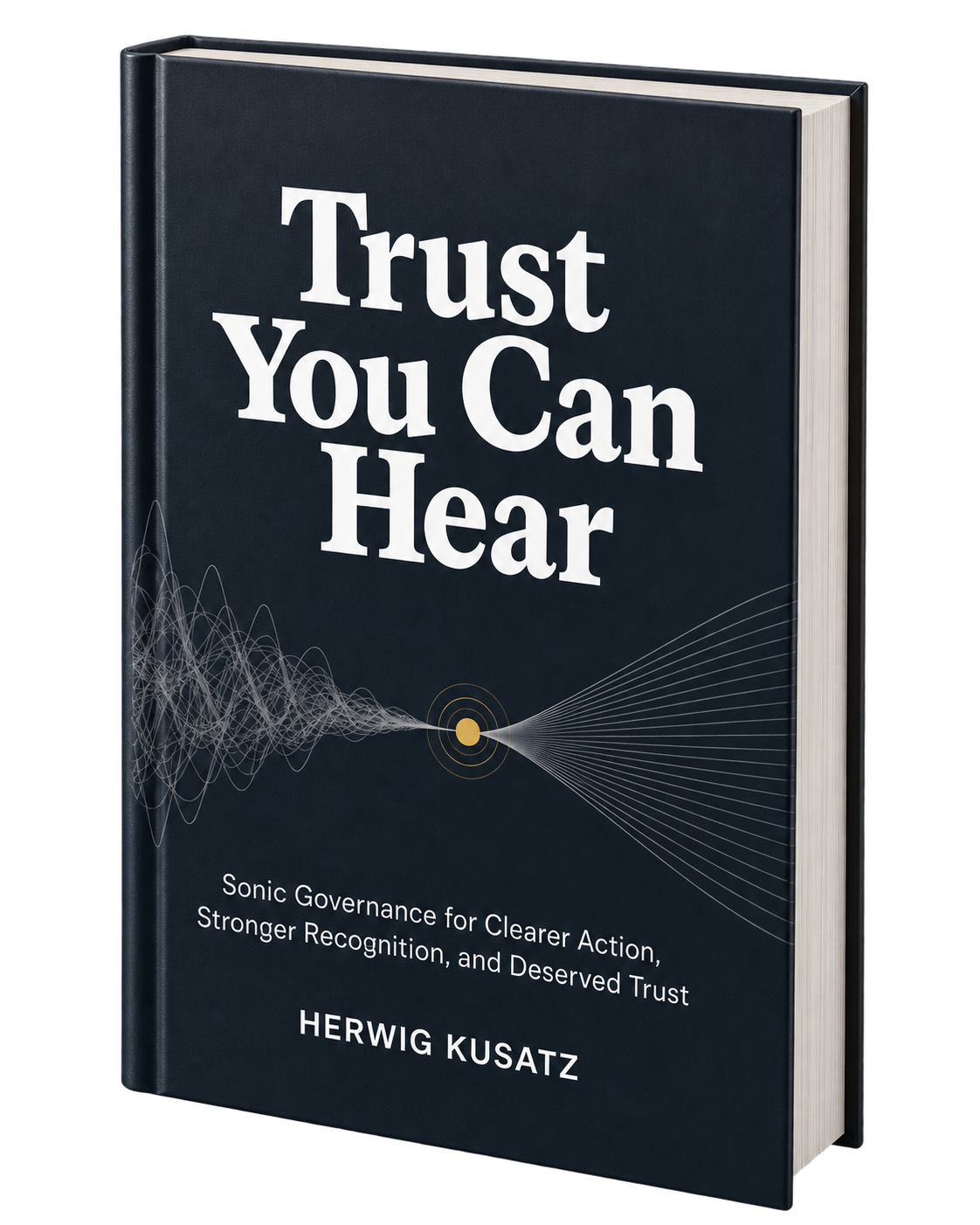
Trust You Can Hear develops the principles, frameworks, and organisational implications behind these examples.
Terms • Privacy • Imprint • Resources